How to Monetize Social Media: Proven Strategies to Boost Income
Virlo Team
Learn how to monetize social media with effective strategies like partnerships and selling products. Turn your content into income today!
Updated on:
Learn how to monetize social media with effective strategies like partnerships and selling products. Turn your content into income today!
Nov 7, 2025

Learning how to monetize social media is all about turning your online presence into a real income stream. It’s a mix of smart strategies—think affiliate marketing, brand deals, and selling your own stuff—but it all starts with building a community that actually wants to hear from you. It’s a marathon, not a sprint, combining engaged followers with business savvy to turn your influence into cash.
Build Your Monetization Foundation First

Before you ever see a dollar, you have to lay the groundwork. This isn’t just about racking up followers; it's about building a genuine community of people who know, like, and trust you. Any money you make is a direct result of the value you provide and the relationships you build.
Trying to monetize right out of the gate is like building a house on sand. It’s unstable and won't last. People follow you for a reason, and figuring out that why is the secret to creating a creator business that sticks around.
Define Your Passionate Niche
The first block in your foundation is a laser-focused niche. This is the specific topic or interest area that all your content will revolve around. It's absolutely crucial to pick something you're genuinely passionate about, otherwise creating content will feel like a chore, and your audience will see right through it.
When you’re excited about what you’re sharing, that energy is contagious. It builds an authentic connection and a loyal community that will be way more open to your recommendations later on. To really nail this, you need a solid plan—starting with an ultimate social media strategy template can help you map out your core content pillars from day one.
When you're picking your niche, ask yourself these questions:
Expertise and Interest: What do you know a lot about, or what are you genuinely excited to share? Your passion is your biggest asset.
Audience Demand: Is there already a community for this topic? A quick search for hashtags or groups on the platform will tell you if people are looking for this content.
Monetization Potential: Can you think of products, services, or brands that fit naturally into this niche? Thinking about this now will make monetization way easier down the road.
Understand Your Target Audience Deeply
Once you’ve got your niche, it’s time to get obsessed with the people you're creating for. Go deep. What are their needs, their goals, their biggest frustrations? What problems are they trying to solve that you can help with?
Your content needs to be their solution. When you consistently provide real, tangible value, you become a trusted authority in their eyes. That trust is the currency of social media—without it, any attempt to monetize is dead in the water. For anyone just getting their start, a detailed content plan is a must. You can dive deeper into this with our complete guide on how to get started as a content creator for more in-depth strategies.
The most successful creators don't just broadcast content; they have a conversation. They listen to their audience, adapt to their feedback, and consistently deliver content that resonates on a personal level.
This deep understanding doesn't just shape your content; it dictates your monetization strategy. You'll know exactly which affiliate product will solve their problem or what kind of digital course would be an instant bestseller for your community.
Develop a Value-Driven Content Strategy
Your content strategy is what connects your niche to your audience. It’s the game plan for what you post, when you post, and how you show up. A winning strategy is all about building engagement and loyalty long before you ever ask for a sale.
Keep things interesting by mixing up your content formats. Think educational tutorials, behind-the-scenes looks at your process, and fun, entertaining videos. The idea is to create a library of content that serves your audience and cements your expertise.
And remember, consistency is everything. Showing up regularly for your audience builds habit and makes you a reliable part of their daily scroll. This foundational work is non-negotiable if you're serious about figuring out how to monetize social media for the long haul.
Secure Profitable Brand Partnerships

Collaborating with brands is a classic way creators make a living, but there’s a massive difference between a one-off sponsored post and a sustainable, long-term partnership. A single post might pay the bills for a month; a real partnership can build your entire business.
The key is to stop thinking of it as a simple transaction. You're not just a billboard for hire. You're a creative partner with a direct, trusted connection to a niche audience—an audience brands would pay a premium to reach authentically.
This is exactly why influencer marketing has exploded. Brands get it now: creators deliver results that traditional ads just can't touch. On average, influencer marketing generates an ROI of $5.78 for every dollar spent. That number is fueled by the deep trust followers have in creators—in fact, 61% of consumers trust influencer endorsements more than they trust typical ads. You can find more insights on social media marketing statistics over at Sprinklr.com.
Finding and Pitching the Right Brands
The most profitable partnerships are born from genuine alignment. Blasting generic emails to hundreds of companies is a surefire way to get ignored. Instead, focus on brands whose products you already use, love, and can confidently recommend to your audience.
Start by making a list of 10-15 dream brands that are a perfect match for your niche and values. Follow them on social media, interact with their posts, and really get a feel for their marketing voice. This initial homework is what will make your pitch stand out from the rest.
When you're ready to reach out, your pitch needs to be more than just a "let's work together" email. It has to tell a story:
Introduce yourself and what makes your content unique.
Explain why you love their brand, maybe mentioning a specific product you can't live without.
Share your audience demographics and spell out why these are the exact people the brand wants to reach.
Propose a specific campaign idea to show you've already been thinking about how to bring them real value.
Build a Media Kit That Sells Your Value
Think of your media kit as your professional resume. It's a quick, visual snapshot of your brand, your audience, and your past wins, making it dead simple for potential partners to see your value. It should look sharp, but more importantly, it needs to sell results, not just numbers.
Forget just listing your follower count. Smart brands know that's a vanity metric. Focus on the data that actually matters to their bottom line:
Metric | Why It Matters to Brands | Example |
|---|---|---|
Engagement Rate | This shows you have an active, interested community, not just passive followers. | "My Instagram posts see an average 4.5% engagement rate." |
Audience Demographics | This proves you reach their target customer. | "My audience is 75% female, aged 25-34, and primarily based in the US." |
Click-Through Rate (CTR) | This shows you can actually get your audience to take action. | "My story links have an average CTR of 2.8%." |
Past Campaign Results | This is the social proof that you can deliver. | "A recent partnership drove 300+ sales for the brand." |
A powerful media kit frames you as a strategic partner, not just another influencer. It answers a brand's biggest question: "What return will we get from investing in this creator?"
Your kit also needs the basics: contact info, links to your social profiles, and a clear breakdown of the types of collaborations you offer—like sponsored posts, video integrations, or multi-platform campaigns. I recommend updating it every quarter to keep your stats and recent successes fresh.
Navigating Negotiations and Contracts
Once a brand shows interest, the real dance begins: negotiation. This is where so many creators sell themselves short. Setting your rates can feel intimidating, but you have to be confident in your value. Research the industry standards for your niche and audience size, but don't forget to factor in the unique value you bring, like top-tier video production or a hyper-engaged community.
State your rate clearly and confidently. If a brand comes back with a lower number, don't just say yes. You can negotiate by adjusting the deliverables—maybe you offer one video instead of two, or you remove an exclusivity clause. The goal is always a win-win where both you and the brand feel like you're getting a great deal.
When you finally get that contract, read every single line. Seriously. Pay close attention to these key areas:
Deliverables: What, exactly, are you expected to create? How many posts? Videos? Stories?
Exclusivity: Are you blocked from working with competitors? If so, for how long?
Content Usage Rights: How can the brand use your content after you post it? And for how long?
Payment Terms: When and how will you get paid? Net-30 (meaning 30 days after you send the invoice) is pretty standard.
Never, ever start creating content without a signed agreement in place. A clear contract protects both you and the brand, setting the stage for a professional, successful, and profitable partnership.
Generate Income with Affiliate Marketing

Affiliate marketing is a fantastic way to make money on social media simply by recommending products you already use and love. You don't have to create anything new. Instead, you're tapping into an existing product and acting as a trusted guide for your audience.
The idea is straightforward: you promote something using a special, trackable link. When someone in your audience clicks that link and buys the product, you get a cut of the sale. It's a win-win—you provide a genuine recommendation that helps your followers, and you earn an income in the process.
Choosing the Right Affiliate Programs
Your affiliate strategy is only as good as the products you stand behind. Picking the right programs is essential for keeping your credibility and making sure your recommendations actually click with your community. Authenticity is non-negotiable. Promoting random, shoddy products will torch the trust you've worked so hard to build.
Stick to partners that fit your niche like a glove. A fitness creator might team up with supplement companies or activewear brands. A graphic designer could promote software subscriptions or their favorite digital asset marketplaces.
There are a few different avenues you can explore:
Large Affiliate Networks: Platforms like Amazon Associates, ShareASale, or Rakuten are great starting points. They give you access to thousands of brands all in one place, which makes finding products to promote incredibly easy.
Direct Brand Partnerships: Lots of companies run their own in-house affiliate programs. These can sometimes offer better commission rates and a closer relationship with the brand, maybe even giving you a heads-up on upcoming sales or new products.
Software and Digital Products: This is where the commissions can get really interesting. Promoting digital goods like courses, e-books, or software often comes with much higher payouts—sometimes as high as 30-50%—because the seller has no physical production costs.
Before you jump into any program, take the time to read the fine print. Every network has its own set of rules about how and where you can share your links. Be sure to check the terms; you can see what's typically covered by reviewing examples of an affiliate program's terms of service.
Integrating Links Naturally into Content
The secret to great affiliate marketing is to recommend, not to hard-sell. People follow you for your unique take on things, so your affiliate links should feel like a natural part of the value you're already delivering. Just dropping links without any context is a fast track to looking spammy.
The best approach is to weave your recommendations right into your content. For instance, a travel creator could make a "What's in My Camera Bag" video and pop affiliate links in the description for every piece of gear they genuinely depend on. This gives their audience real value by answering a question they probably already have.
The most effective affiliate promotions don't feel like promotions at all. They feel like a helpful friend giving a great recommendation. Your primary goal should always be to solve a problem or fulfill a need for your audience.
Here are a few creative ways to share your affiliate links:
Tutorials and How-To Guides: Show your audience how a specific product helps them get a result.
Product Reviews and Comparisons: Give your honest take on different products to help your followers make smart buying decisions.
"Favorites" or "Essentials" Lists: Put together curated lists of your must-have tools or top monthly picks in your niche.
Story Links and Link-in-Bio Tools: Use Instagram Stories' link sticker or tools like Linktree to make it super easy for followers to find your recommended products.
Tracking Performance and Maintaining Trust
If you want to succeed with affiliate marketing long-term, you have to be upfront with your audience. Always disclose that you're using affiliate links. A simple disclaimer like (#ad) or (affiliate link) usually does the trick and is legally required in many places. This kind of honesty is what builds real trust.
Beyond that, you need to track what's working. Most affiliate dashboards give you detailed analytics on clicks, conversion rates, and your total earnings for each link. Pay close attention to this data. It tells you exactly which products your community is interested in.
If a certain type of product is getting a lot of clicks and sales, that's a huge signal to create more content around it. This data-driven approach is how you scale your efforts and turn affiliate marketing into a steady, reliable source of income.
Create and Sell Your Own Products
Once you move past affiliate links and brand deals, you get to the holy grail of monetizing your social media: selling your very own products. This is where you take complete control. You’re not just getting a cut; you’re capturing 100% of the profits and building a real, sustainable business that doesn’t rely on anyone else.
This is the big leap from being an influencer to becoming an entrepreneur.
When you create something from scratch, you're not just recommending a solution—you are the solution. It builds an incredible amount of trust with your audience because your name and reputation are attached directly to the product. Honestly, it's the most direct way to turn loyal followers into lifelong customers.
Brainstorming Product Ideas Your Audience Will Love
The best product ideas aren't dreamed up in a vacuum; they come straight from your audience. What questions pop up in your DMs over and over? What problems are they always trying to solve? Your most successful product will feel like a natural next step, an answer they were already looking for from you.
Start with your expertise. A fitness creator could design a killer 12-week workout program. A home chef could bundle their best recipes into a beautiful e-book. A photographer could sell the custom Lightroom presets they use to get their signature look. The goal is to package your knowledge or talent into something your followers can buy.
Your options generally fall into two buckets: digital or physical.
Digital Products: Think online courses, e-books, exclusive content memberships, or digital planners. These are amazing because they're infinitely scalable and often have sky-high profit margins. No manufacturing, no shipping—just pure value.
Physical Products: This is anything tangible, like branded merch (t-shirts, hats, mugs), custom-designed goods, or even a curated subscription box. They involve a bit more logistical juggling with inventory and shipping, but there’s nothing quite like having your community hold a piece of your brand in their hands.
This infographic really nails the key differences between the two.
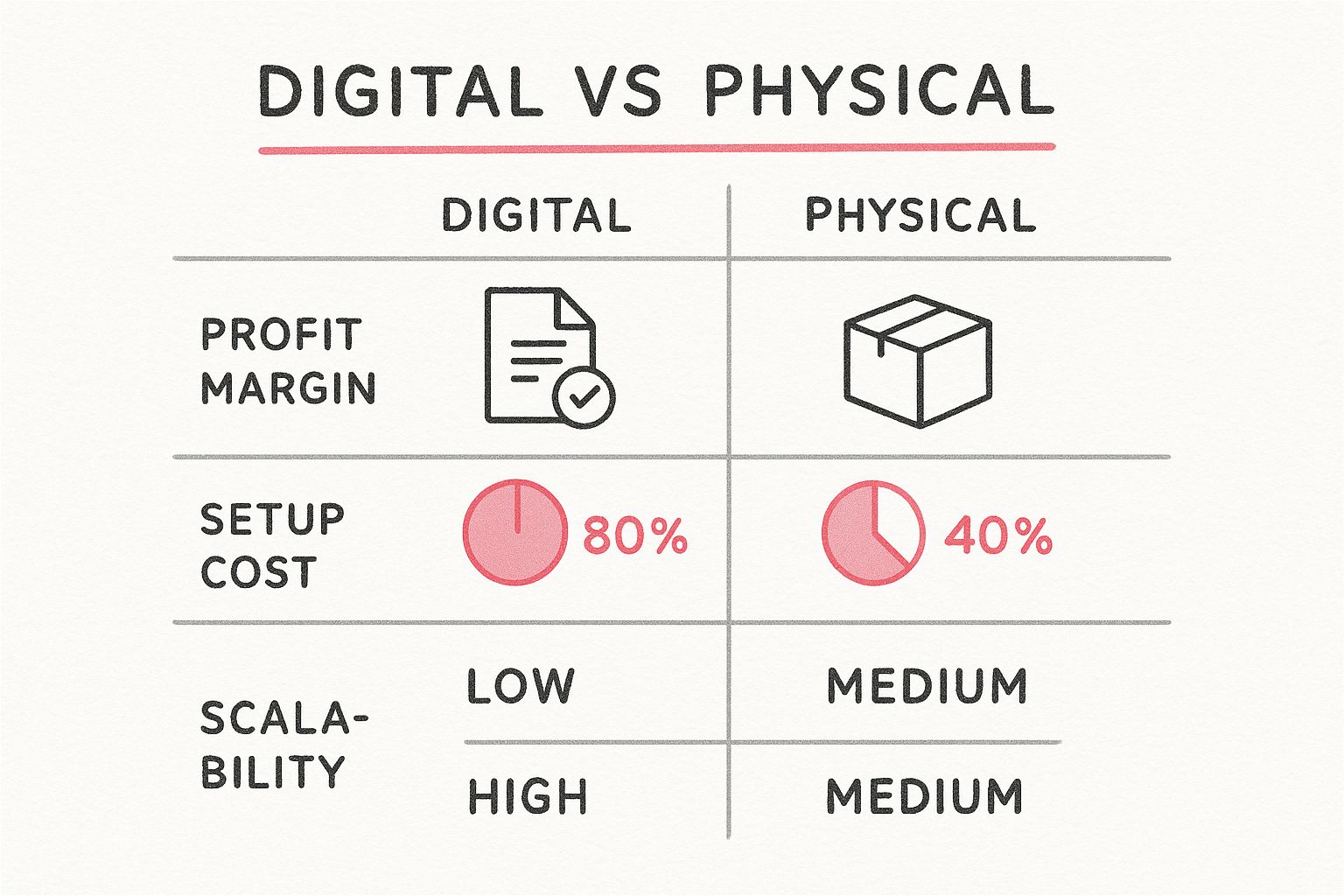
As you can see, digital products are tough to beat on profit margins and scalability, with way lower setup costs. That's why they’re such a popular first step for creators venturing into e-commerce.
Setting Up Your E-commerce Storefront
Once you’ve landed on a product idea, you need a place for people to buy it. The good news is that setting up an online shop is easier than ever, and you definitely don’t need to be a coding whiz. The platform you choose will really depend on what you're selling and where your audience hangs out.
Many social platforms have built-in shopping tools that make the whole process incredibly smooth. Instagram and Facebook Shops, for instance, let people browse and buy your products without ever leaving the app. Reducing that friction is huge for boosting sales.
For more firepower and customization, dedicated e-commerce platforms are the way to go.
Platform | Best For | Key Feature |
|---|---|---|
Shopify | Creators selling pretty much anything—physical or digital—who want a robust, all-in-one solution. | A massive app store for everything from marketing to shipping. |
Gumroad | Digital creators selling e-books, courses, presets, and memberships. | Insanely simple setup; it even handles VAT/sales tax for you. |
Etsy | Creators of handmade or unique physical goods. | Taps you into a huge, built-in marketplace of eager buyers. |
The beauty of these platforms is that they integrate directly with your social media profiles. You can tag products in your posts and stories, sending people straight to a checkout page. It’s the perfect combo: a professional storefront powered by the massive promotional engine of social media.
Launching and Promoting Your First Product
A product launch isn't just a single "it's live!" post. Think of it as a full-blown campaign. Your job is to build hype and anticipation long before anyone can actually click "buy now."
Start teasing the product on your social channels. Share behind-the-scenes glimpses of the creation process. Get your audience involved by letting them vote on designs or features—it makes them feel like part of the journey. Map out a content calendar specifically for the launch, mixing posts, stories, and videos that show off the product's benefits in action.
A successful product launch leverages the community you've already built. It's not about yelling into the void; it's about starting a conversation with people who already trust your voice and are eager to support your next move.
When launch day arrives, make your product the star of the show. Update your link-in-bio, use countdown stickers in your stories, and maybe even go live to answer questions in real-time. That initial wave of sales is critical for building social proof that encourages others to jump in.
And if you really want to pour some fuel on the fire, looking into how to use AI to launch ads can be a game-changer. This approach can help you dial in your campaigns with precision, ensuring your product gets in front of the exact people who need to see it, right when they're ready to buy.
Beyond brand deals and affiliate marketing lies a powerful way to make money directly from your content: platform-native monetization tools.
Social media giants are finally building direct paths for creators to earn a living right where their audience already is. Tapping into these features is a game-changer. It means you can monetize the views and engagement you're already getting without sending your followers somewhere else to click a link or buy a product.
Earning with Ads and Revenue Sharing
One of the most straightforward methods is getting a piece of the ad revenue your content generates. In this model, the platform rewards you for making videos that keep people watching by placing ads before, during, or after your content and kicking a slice of that income back to you.
The YouTube Partner Program (YPP) is the undisputed king here. Once you hit the magic numbers—1,000 subscribers and 4,000 watch hours in the last 12 months—you can switch on ads for your videos and Shorts. It's a direct reward for building a loyal audience.
Facebook offers something similar with its In-Stream Ads. If you meet their criteria, you can place short ads in your videos and earn money based on how many people see them.
Social media ad spending is on a tear, projected to hit around $276.7 billion in 2025. A staggering 83% of that is expected to come from mobile ads by 2030, which gives platforms every reason to keep creators like you churning out the engaging content that ad dollars follow. For a deeper dive, check out the social media advertising insights on sproutsocial.com.
Unlocking Direct Fan Funding
Platforms are also rolling out more personal ways for your biggest fans to support you directly. These tools turn passive viewers into active patrons, building a stronger community and opening up a completely new income stream.
Think of them as a digital tip jar or an exclusive club.
Subscriptions: Both Instagram and TikTok now have subscription features. Followers can pay a monthly fee for exclusive content, special badges, or private chats, giving you a predictable, recurring income.
Tips and Badges: During live streams, features like YouTube Super Chat, Super Stickers, and Instagram Badges let viewers pay to have their comments highlighted. It's a fun way for them to show some love and grab your attention.
Gifts: On TikTok, viewers can send virtual "Gifts" during your live videos, which you can later convert into real money. This gamifies the process and can be incredibly lucrative during high-energy live events.
Navigating Creator Funds
Creator funds were introduced as a way for platforms to pay creators for popular content without relying on ads. The TikTok Creator Fund is the most famous example, paying eligible creators based on the performance of their videos.
It's crucial to understand how these work, though. The payouts aren't always tied to a specific view count. Instead, they're calculated using a complex mix of factors like engagement and where your viewers are from. While it can be a nice bonus, most top creators view it as a supplementary income, not their main hustle. Our guide on how much TikTok pays creators breaks down the potential earnings in more detail.
Before you can start earning, you'll need to hit certain milestones. The primary methods for monetizing on-platform have different requirements and potential returns.
Social Media Monetization Methods Overview
Here's a quick comparison of the main ways you can earn money directly through social media platforms. Each method requires a different level of commitment and offers varying income potential, making some better suited for beginners and others for established creators.
Monetization Method | Effort Level | Income Potential | Best For |
|---|---|---|---|
Ad Revenue Sharing | Low to Medium | Medium to High | Creators with consistent viewership |
Affiliate Marketing | Medium | Medium to High | Niche creators with engaged audiences |
Brand Sponsorships | High | High | Established creators with strong influence |
Direct Fan Funding | Medium | Low to Medium | Creators with a loyal, dedicated community |
Creator Funds | Low | Low to Medium | Viral creators on specific platforms |
Selling Products | High | High | Creators with a strong brand and product idea |
This table should give you a clearer picture of where to focus your energy based on where you are in your creator journey. While brand sponsorships might be the end goal, starting with ad revenue or fan funding can build a solid foundation.
Qualifying for Platform Monetization
Every tool comes with its own set of rules. Platforms want to make sure they're rewarding creators who are established, consistent, and play by the community guidelines.
Before you can even apply, you’ll typically need to hit specific thresholds. These usually fall into three main categories:
Requirement Category | Description | Common Examples |
|---|---|---|
Follower Count | The minimum number of followers or subscribers you need. | 1,000 subscribers for YPP; 10,000 followers for TikTok Creator Fund. |
Engagement/Views | The amount of viewership your content has received recently. | 4,000 public watch hours on YouTube; 100,000 video views on TikTok. |
Account Standing | Your account must be in good standing, with no major violations. | No community guideline strikes; must be an authentic, active presence. |
Meeting these requirements is your first big step. Once you're in, the real work begins: creating content that not only your audience loves but that also plays well with the platform's monetization features to truly maximize your earnings.
Common Questions About Monetizing Social Media
When you start thinking about turning your social media presence into an income stream, a million questions pop up. It's totally normal to feel a mix of excitement and "am I doing this right?" Let's clear up some of the most common questions with some straightforward, real-talk advice.
How Many Followers Do I Need to Start Earning?
This is the big one, and the answer might surprise you: it’s less about the number and more about the engagement. Forget the myth that you need 100,000 followers to make a dime. In fact, micro-influencers (those with 1,000 to 100,000 followers) are often a goldmine for brands because their engagement rates are through the roof.
You can actually start with affiliate marketing when you have just a few hundred dedicated followers who genuinely trust what you say. Think about it: many brands would kill for a 3-5% engagement rate from a tight-knit community over a measly 0.5% rate from a huge, indifferent crowd.
How Do I Set My Rates for Brand Deals?
Pricing your work feels tricky at first, but the worst thing you can do is sell yourself short. A common rule of thumb is to start at about $100 per 10,000 followers for a single sponsored Instagram post, but please, treat that as the absolute floor. Your rate should be a cocktail of several factors:
Engagement Metrics: If your comments and saves are popping off, your price should reflect that.
Content Production Costs: Your time, gear, and sheer creative energy have value. Bake that into your price.
Usage Rights: If a brand wants to use your photo in their own Facebook ads, that’s a separate fee. Always.
Exclusivity: Agreeing not to work with a competitor for a few months? That’s worth more, too.
Do some digging to see what creators of a similar size in your niche are charging. Then, when you pitch your rate, do it with confidence and be ready to explain the value you bring to the table.
The biggest mistake I see new creators make is undervaluing their influence. Your unique connection with a specific audience is a powerful marketing tool that brands are willing to pay for. Price your work based on the value you provide, not just your follower count.
Should I Focus on One Monetization Method?
It’s tempting to just master one thing, but that’s a risky game. Diversifying your income streams is the key to long-term stability. Putting all your eggs in the brand-deal basket makes you vulnerable when a company suddenly slashes its marketing budget. Likewise, if an affiliate program changes its commission structure overnight, your income could take a serious hit.
The smart move is to layer your monetization strategies. You could be earning from YouTube ad revenue, dropping affiliate links in your video descriptions, and selling your own digital products on the side. This mix creates a much more resilient business.
A powerful approach is to build a funnel. Use affiliate marketing and brand deals to generate cash flow while you build your own product—like an online course, an ebook, or a preset pack. This gradually shifts your reliance from other companies to your own brand, giving you the ultimate control over your financial future.
Ready to stop guessing and start growing? Virlo is the data-driven platform that helps you discover viral trends, generate content ideas, and create high-performing videos faster. Turn insights into income. Get started with Virlo today!
More posts


Join the Virlo newsletter for free viral ideas
Empowering your success as a creator